
In-vitro fertilization (IVF) is a highly effective assisted reproductive technology (ART) that helps couples struggling with infertility conceive a child. At Omkilkaril IVF, we provide advanced IVF treatments with personalized care to ensure the best possible outcomes.
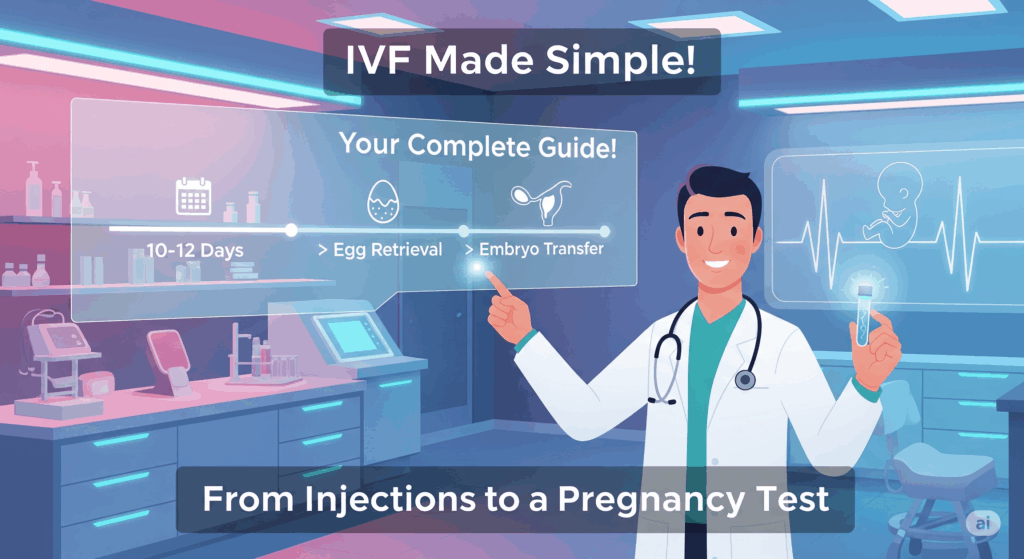
If your doctor has recommended IVF, you may have questions about the process, duration, and steps involved. This blog will guide you through each stage of IVF treatment at Omkilkaril IVF.
Step 1: Initial Consultation & Counseling
Before starting IVF, you will have a detailed counseling session where:
- The IVF process, success rates, and costs are explained.
- Any doubts regarding injections, procedures, and medications are clarified.
- A fertility specialist evaluates your medical history and recommends a customized treatment plan.
Step 2: Ovarian Stimulation (Injections for Egg Growth)
The first active step in IVF involves hormonal injections to stimulate the ovaries to produce multiple eggs.
- Duration: 10–12 days (varies case by case).
- Monitoring: Ultrasounds and blood tests track egg growth.
- Injections: Some patients require 1–2 injections daily, depending on their response.
Once the eggs are mature, a trigger shot (final maturation injection) is given. Egg retrieval is scheduled 36 hours after the trigger.
Step 3: Egg Retrieval (OPU – Oocyte Pickup)
- A minor 15-minute procedure under sedation.
- A thin needle is used to collect eggs from the ovaries.
- The process is painless, and recovery is quick.
After retrieval, the eggs are immediately sent to the IVF lab for fertilization.
Step 4: Sperm Collection & Fertilization
- On the same day as egg retrieval, the male partner provides a sperm sample.
- The sperm is processed, and the best-quality sperm is selected.
- Fertilization happens via:
- Conventional IVF (sperm and egg placed together)
- ICSI (Intracytoplasmic Sperm Injection) – a single sperm is injected into each egg.
The fertilized eggs (embryos) are cultured in a lab for 3–5 days.
Step 5: Embryo Development & Selection
- Day 1–2: Check for fertilization success.
- Day 3: Embryo reaches cleavage stage (6–8 cells).
- Day 5: Embryo becomes a blastocyst (higher success rate).
The best-quality embryo(s) are selected for transfer.
Step 6: Embryo Transfer (Fresh or Frozen)
A) Fresh Embryo Transfer
- Done 3 or 5 days after egg retrieval.
- A thin catheter places the embryo into the uterus.
- Pregnancy test after 14 days.
B) Frozen Embryo Transfer (FET)
- Recommended if:
- Hormone levels are too high.
- Endometrial lining isn’t optimal.
- Genetic testing (PGT) is needed.
- Process:
- Embryos are frozen and stored.
- After 1–2 months, the uterus is prepared with hormones.
- Embryos are thawed and transferred in a natural or medicated cycle.
Step 7: Post-Transfer Care & Pregnancy Test
- Progesterone support (injections/medications) continues for 14 days.
- A blood test (Beta hCG) confirms pregnancy.
- If positive, an ultrasound follows in 2 weeks to check fetal development.
How Long Does IVF Take?
- Fresh IVF Cycle: 15–20 days (from injections to transfer).
- Frozen Embryo Transfer (FET): 2–3 months (including preparation).
Why Choose Omkilkaril IVF?
✅ Experienced fertility specialists
✅ Advanced lab technology
✅ Personalized treatment plans
✅ High success rates
✅ Transparent pricing & emotional support
Final Thoughts
IVF is a structured process with multiple steps, but with expert guidance, it becomes manageable. At Omkilkaril IVF, we ensure you receive the best care at every stage.